SoFiUSD Stablecoin Goes Live on Polygon's Open Money Stack
SoFi Bank's dollar stablecoin SoFiUSD is now on Polygon's Open Money Stack, its third chain, with in-app access for over 17 million SoFi members.
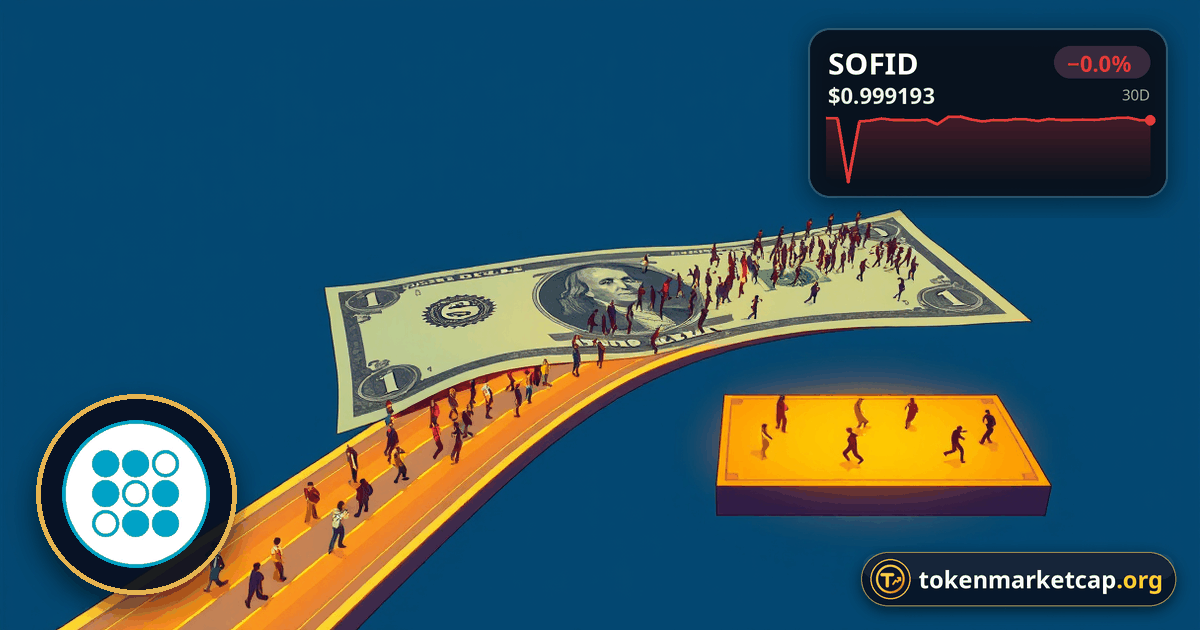
SoFiUSD, the dollar-pegged token from SoFi Bank, is now available on Polygon, the third blockchain to carry the stablecoin after Ethereum and Solana. Polygon Labs announced on Thursday that the token has been plugged into its Open Money Stack payments layer. SoFi's customer base, put at over 17 million people, can trade, store and swap the Polygon version from inside the SoFi app, with no external crypto wallet and no manual bridging between networks.
What changes for SoFi users and businesses
For retail customers the difference is mostly convenience: a third network appears in an app they already use, and the cross-chain mechanics stay out of sight. The larger shift is on the business side. Polygon describes Open Money Stack as a payments layer that packages several services behind one integration:
- conversion between traditional currency and tokens in both directions,
- wallets built directly into a company's own product,
- settlement that spans more than one blockchain.
That plumbing gives companies a route to pay out funds, settle obligations and move money internationally using SoFiUSD, with links to local currencies and conventional bank rails. The token is not alone there. PayPal's PYUSD, Tether's USDT and Circle's USDC are already supported on the same stack, so SoFiUSD enters as a newcomer among much more established dollar tokens.
Background: a stablecoin from a nationally chartered bank
SoFi is a U.S. consumer finance company that owns a bank, and the bank is the issuer of the token. SoFi Bank answers to the OCC, the federal regulator of national banks. That sets SoFiUSD apart from most dollar tokens, which have historically come from crypto-native firms or payment companies, not from banks. When the token debuted late last year on Ethereum and Solana, it was billed as the first of its kind from a national bank in the United States.
Each SoFiUSD can be exchanged for one U.S. dollar. Decrypt reports that the token is already in real use inside the company: SoFi's whole card programme is settled with it across Mastercard's network. The firm has also recently introduced SoFi Earn, a tokenized deposit product with a 4.40% yield that can be swapped into SoFiUSD at par.
The bank connection has limits. SoFiUSD is classed as a payment stablecoin, not a deposit. It carries no FDIC or SIPC insurance, has no bank guarantee and does not count as legal tender.
Why Polygon wanted this integration
Payments have become one of the main ways Polygon presents itself. The company says cumulative stablecoin transfers on the chain have passed $3 trillion. Both major card networks, Visa and Mastercard, can settle in stablecoins there, and Stripe relies on the network when directing USDC payments on behalf of merchants across 150-plus countries. Polygon also recently extended Open Money Stack to Solana, so the product is no longer tied to a single chain.
Adding a bank-issued token gives that business a new kind of issuer. Polygon Labs chief executive Marc Boiron said SoFi pairs "the regulatory foundation of a national bank" and the reach of a large consumer and enterprise platform, which in his view leaves it well placed to bring stablecoins into mainstream finance.
Our take: distribution is solved, usage is the open question
The announcement fits a broader pattern in which stablecoins are moving out of exchange trading and into card settlement, business payouts and cross-border transfers. SoFi brings two things at once: a regulated bank as issuer and a ready-made audience of millions of app users.
What the sources do not provide is any measure of demand. There is no figure for how much SoFiUSD is in circulation, how much of it is expected to move to Polygon, or what businesses will pay to use it through Open Money Stack. Nor is there any indication of how the launch affects Polygon's own token, POL.
Three things are worth watching: whether SoFi or Polygon publish on-chain volume for the token, whether outside businesses adopt it for payouts in addition to SoFi's own card settlement, and whether other nationally chartered banks follow with tokens of their own. Until such numbers appear, this is best read as an expansion of reach, with adoption still to be shown.
이 기사 어떠셨나요?
출처
기사 정보
TokenMarketCap 뉴스 데스크에서 작성했습니다. 동일한 이슈에 대한 여러 독립적인 보고서를 검토하여 직접 기사를 작성하며, 타사의 텍스트를 재배포하거나 번역하지 않습니다. 수치는 게시 전에 출처와 대조하여 확인합니다.
이 글은 정보 제공용이며 투자 조언이 아닙니다. 결정을 내리기 전에 직접 조사하세요.